
Greenbuying

Call us on 0845 217 8995

Ten Tips for a Green Office

Calendar Posted 5 January 2012 | Feed Icon | Calendar 0 Comments

GreenBuying.co.uk, which sells thousands of eco friendly office supplies online, offers the following ten tips for a greener office.

“These are simple yet effective steps that every office should take to reduce its environmental impact. These tips carry additional benefits and will appeal to a financial or business director.”

Use less paper

Following the growth in the internet and email, the use of paper within offices has grown significantly. The ‘paper-less office’ that was predicted has not materialised as people print off every email, map and countless documents. Most documents have a life expectancy of less than one day and are then thrown away. By reducing the amount of paper used in your office you can cut both the environmental impact and financial costs of running your business. As a standard your office should switch to double-sided or ‘duplex’ printing. Those with good-reasonable eye-sight may also want to print two pages to a side as well. Other methods of reducing paper use include altering document design templates and putting a message in your email signature saying ‘do you really need to print this email?’

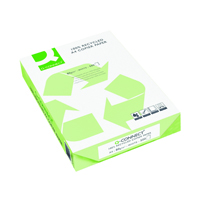
Switch to recycled paper

Using recycled paper uses up to 70% less energy than virgin paper and demands the use of fewer natural resources. The use of paper with recycled content typically uses less energy therefore helping to cut your offices carbon impact. A few years ago recycled paper was often sneered at as it was generally regarded as being of poorer quality than paper from virgin sources. Not any more. Independent surveys have proven that recycled paper is comparable to virgin sources in quality and performance. By switching to recycled paper in your office your organisation can make a significant improvement to safeguarding the environment.

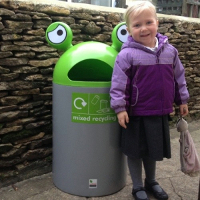
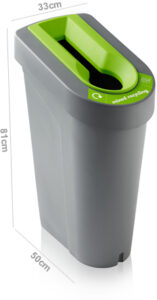
Provide recycling facilities

According to a survey conducted by WRAP, 93% of companies who set up recycling facilities at work believe it's easy to implement and maintain. Evidence suggests it is simple to provide recycling points for common office waste sources such as paper, plastic bottles, drink cans and ink cartridges. Organisations can also look to recycle other types of waste such as light bulbs and tubes, IT equipment and furniture. With the UK landfill tax at £24 per tonne and set to rise for the foreseeable future, it not only makes sense for environmental reasons but it can also make good financial sense.

Reduce the number of waste bins in your office

Once you have provided recycling facilities, reducing the number of general waste bins is a great way to ensure people don’t throw away recyclable items. Taking away individual waste bins and locating them further away than recycling facilities is a great way of encouraging recycling. At first staff may complain that they have to walk further. However from my experience these objections will soon pass, as after a few weeks habits change.

Fit water saving devices

The Building Research Establishment has set a best-practise benchmark target for employee water consumption of 4m³ per year. To calculate your employee water consumption simply calculate your annual water use per employee:

Annual Water consumption / Number of Employees = Water Consumption per annum

If your water consumption is over 10m³ per employee you should consider having a water audit of your office. Alternatively switching to water saving devices in your office can help reduce consumption. With the increase use of water meters by water companies it also makes financial sense to fit water-saving devices.

Promote Sustainable Transport at work

UK Government figures show that 18% of all greenhouse gas emissions are a result of road transport. To help reduce your offices contribution to climate change it is important to look at how your employees come to work and take measures to help promote more sustainable transport patterns. By setting up a Green Transport plan to support and promote public transport, walking, cycling and car sharing your office can cut its contribution to climate change. Such measures can also encourage employees to become more active which carries a number of benefits to both them and your organisation.

Turn off the lights …and all non essential electrical equipment

Saving energy is one of the most effective ways to helping to reduce your businesses contribution to climate change. According to the Carbon Trust businesses are currently responsible for about half of all the UK’s carbon emissions. By turning off equipment that isn’t being used, such as air conditioning in the winter, your office could reduce its energy use. This can also translate into financial benefits - business profits can be increased by 5% by adopting energy saving initiatives.

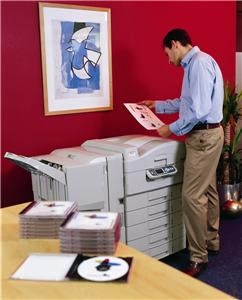
Consider replacing inefficient office equipment

By purchasing new office equipment it is possible to make quick savings, both financially and for the environment with smart product selection. For example, photocopiers on the market can save energy with "low-power" and/or "off" modes after a period of inactivity. They can also print double-sided saving paper. Such smart purchases can result in significant savings in a short space of time.

Switch to renewable energy

The majority of the UK's electricity comes from burning fossil fuels such as coal and gas. This is a major contributor to climate change. Switching to renewable sources of energy such as wind and solar power to run your office helps cut your carbon emissions but also helps support the uptake of green energy which is vital in the move towards a low-carbon economy.

Run a communication programme

It is important that all members of staff are aware of the reasons for promoting environmental initiatives in the office. By running a positive campaign that is both engaging and fun it is possible to create a culture in your office that will provided added value.

by GreenBuying.co.uk | 5 January 2012

Austerity, Opportunity & Responsibility

Calendar Posted 8 August 2011 | Feed Icon | Calendar 0 Comments

The latest paper added to our articles section applies lessons from sustainability to spending cuts, in search of doing better. It identifies four areas in which cost savings can help improve the long term viability of an organisation. It is aimed at those who need to achieve cost savings, yet believe there is a more intelligent approach than simply swinging the axe.

by Mark Hedges & Del Redvers | 8 August 2011

How can my business reduce its landfill tax liability?

Calendar Posted 20 July 2011 | Feed Icon | Calendar 0 Comments

Any business that has to dispose of waste is being clobbered by landfill tax which seems to increase every year. So how can we reduce this cost?

Landfill Tax is charged according to the weight of material deposited.

There are two rates of Landfill Tax: the lower rate only applies to inactive or inert wastes listed in the Landfill Tax (Qualifying Material) Order 2011; the higher rate applies to all other waste that is taxable for Landfill Tax purposes and is chargeable at the standard rate.

The lower rate is £2.50 per tonne from 1 April 2010 to 31 March 2012.

The standard rate is £56 per tonne from 1 April 2011 to 31 March 2012 and will increase to:

£64 per tonne on 1 April 2012

£72 per tonne on 1 April 2013

£80 per tonne on 1 April 2014

So how do business reduce this cost?

Well here's one idea: ScrapShop.co.uk has come up with an innovative free-to-use waste exchange...simply register as a member on the site, then you can advertise that you've got some waste materials and any of the other registered members can then get in touch with you directly to arrange shipment and any payment if applicable.

It's a new service, and its aim is to reduce the amount of materials being thrown into landfill sites. But it can also reduce your tax bill and even raise revenues!

by M Roper | 20 July 2011

Tips for a Greener Workplace (Part 7)

Calendar Posted 23 March 2011 | Feed Icon | Calendar 0 Comments

In keeping with our previous posts, here are some more tips to be greener in the work place:

1. Use the Mailing Preference Service

This service is used by people who do not wish to receive marketing mail. This will reduce unwanted mail and the energy used in printing, delivery and disposal of it.

2. Business Cards

Business cards obviously use paper and ink, so try to limit their use. If possible, try to use recycled paper business cards.

3. Biomass Boilers

This can be an environmental alternative than conventional boilers. Biomass is an organic plant matter, such as wood or straw. Unlike using fossil fuel such as oil or coal, biomass is labelled as carbon neutral as the CO2 that is burnt is equal to the CO2 absorbed from the atmosphere during the plant’s life. Although they are more expensive to install than traditional boilers, according to the Energy Saving Trust, having a biomass boiler could save you £950 per year. With the soaring price of oil, this potential price saving could increase.

4. Solar Panels

Although this can be a big investment, companies are increasingly installing photovoltaic (PV) solar panels on office roofs to generate electricity and so take less power from the national grid.

However there is some controversy at present in the UK relating to solar panels; the government is planning to reduce the feed in tariff for large solar production. The feed in tariff was designed so that electricity generated by solar could be bought by the National Grid at a subsidised price. The government is considering cutting this tariff for any solar installation that produces 50kw or more electricity. Analysts argue that this may put businesses off installing solar panels, but regardless of this threat, solar panels are likely to remain a popular green option for energy usage.

5. Turn the heating down!

Finally, a more simple tip- now that spring appears to be on its way, turn the heating or air conditioning down in your office. It is said that for every additional degree in temperature, you can pay an extra 8% in heating costs. This can be a quick and easy way of saving your business money whilst also being more energy efficient at the same time.

Stayed tuned for further environmental tips from your online source of green business supplies, GreenBuying.co.uk.

by Dan Atiyah | 23 March 2011

Tips for a Greener Workplace Part 6

Calendar Posted 4 March 2011 | Feed Icon | Calendar 0 Comments

In keeping with our recent blogs, here are some further green tips for the workplace.

1. Avoid Air Fresheners

Many of these products contain volatile organic compounds (VOCs) and other environmentally unfriendly chemicals. Plug-in air fresheners are even worse as they use electricity as well. Either use natural air fresheners or just open that window!

2. Vending Machines

If you have a vending machine at work, think about putting in a timing device for it. This can turn off the machine at night, saving energy and money. On average if a vending machine was switched off at nights and weekends, it will save a tonne of CO2 a year.

3. Heat Reflector on Radiators

If it has not already been done, put a reflective panel behind the radiator. Up to 70 % of the heat from the back of the radiator can be used to heat the wall behind it. By using a reflective panel, this will bounce this wasted heat back into the room.

4. Go for a flat screen

If your office still has some old PC’s with the old CRT monitors, think about replacing them. The newer flat-panel monitors use up to less 50% electricity to run, saving your business money and energy. Please remember to recycle all your old monitors though.

5. Insulate your pipes

This can be a quick and easy option to reduce energy use in the workplace. Buy some pipe insulation foam strips and place them on the pipes.

Stay tuned for further green tips on the GreenBuying.co.uk blog.

by Dan Atiyah | 4 March 2011

Green Transport; Barcelona's cycling scheme

Calendar Posted 25 February 2011 | Feed Icon | Calendar 0 Comments

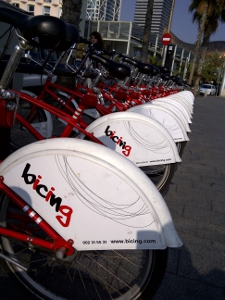
I was in Barcelona recently (the weather was considerably more pleasant than here in the UK!) and was very impressed by their city centre bicycle scheme, known as "Bicing". There are many stations across the city (including the one shown in the photograph) and everywhere I looked, there seemed to be people riding these distinctive looking bicycles. And it got me reflecting on how we do things here in Britain.

Whilst there are now some limited examples of similar schemes in the UK, most large towns and cities still lack such schemes to encourage people to stop using their cars and to get on a bike instead - thus reducing the carbon emissions and making people healthier too.

And when one considers companies and public sector organisations, there is even less innovation and encouragement. Why can't more companies follow the Spanish example and offer their staff access to free (or at worst, subsidised) bikes? I would be very interested to hear from anyone who has a bike scheme at work, and whether the scheme has been successful at getting people out of their cars....

by Matt Roper | 25 February 2011

Tips for a greener Workplace (Part 5)

Calendar Posted 24 February 2011 | Feed Icon | Calendar 0 Comments

Hello again. There are hundreds of often small changes that could really make your work places more sustainable. Here at greenbuying.co.uk we have been giving tips in our blog. Here are this week’s top five.

1. Reduce your water use.

According to the Environment Agency, the average person uses 150 litres of water a day. Our water consumption has gone up by nearly 50% in the last 25 years, and that is putting further pressure on a scant and vital resource. At work make sure there are no leaky taps, use water displacement devices in the toilets and use a water-efficient dish washer in the staff kitchen.

2. Recycling containers.

Have recycling containers at the workplace to make it easy for employees to use (note that we sell a large range of internal and external recycling bins on our eco shop).

3. Re-use old stationery & cardboard boxes.

Reuse old boxes for shipping, and reuse old files again rather than throwing them away and buying new ones.

4. Lighting.

Artificial lighting uses around 44% of all electricity use in office buildings. In a period of increasing energy costs, smart use of lighting will save your business money as well as helping the environment. Try to go without artificial light if natural light is good enough to work with. If you do need lighting, try and install a motion sensor light switch. If that is not possible, always make it a habit to turn lights off if you are going to leave a room empty for 15 minutes or more.

5. Donate your old office equipment.

Instead of throwing away your office’s old equipment and furniture, try to contact organisations that can take these products and re-use them. There are many charitable organisations that specialise in this. Alternatively, you can place your unwanted equipment onto our free "scrap shop" service (found via our website greenbuying.co.uk). However do remember that as a business you have to follow the EU Waste Electrical and Electronic Equipment (WEEE) regulations. The Environment Agency website has lots of detail on this subject.

Stay tuned for further green tips on the www. greenbuying.co.uk blog.

by Dan Atiyah | 24 February 2011

Tips for a Greener Workplace (Part 4)

Calendar Posted 22 February 2011 | Feed Icon | Calendar 0 Comments

Hello again, and welcome to the greenbuying.co.uk blog. In the past few weeks we have been giving some tips for business to try and become greener in the workplace. Here is the latest instalment:

1- Take the train

When you have to go to a meeting out of the office (and it can’t be done by video conferencing- see previous blogs) consider using the train as transportation. Train journeys are up to 75% more CO2-efficent than the airline equivalent, and are better for the environment than a car journey. According to Defra (2007) a train gives off 60g of CO2 emissions per passenger, compared to 133g for an average car and 158g for a domestic flight.

An average person has around 40% of their carbon footprint based on travel, so a few small changes of habit in this area could make all the difference.

2-Travel light if you have to fly

If you do have to fly for business, make sure to travel light. The heavier luggage that is checked in, the more fuel the plane will burn up. For example if you had to go on an eight hour flight and you checked in with bags weighing 10kg instead of 20kg, you would help to save over 4 litres of aviation fuel.

3-Use rechargeable batteries

When you can, use rechargeable batteries. The energy required to manufacture a battery is around 50 times more than the energy that it gives out, so by re-using them you will save a lot of energy. It is also better for the environment as batteries do contain some toxic metals.

4-Recycle your old CD’s

All your old CD’s in the office can also be recycled, including the cases as well. Don’t just throw them away; put them in a recycling bin so the materials can be re-used.

5-Dump the screensaver

The uses of screensavers for computers are misleading. They are really designed to prevent screen burn, when an image that has been left unchanged for too long is on screen. In fact they can use up a lot of energy. A PC with a wacky screensaver on can use up to 100 watts, whereas if it is in sleep mode, it will consume around 10 watts. Dump the screensaver and put in a stand-by mode for your computer.

Stay tuned for further green tips on the GreenBuying.co.uk blog.

by Dan Atiyah | 22 February 2011

Tips for a Greener Workplace Part 3

Calendar Posted 26 January 2011 | Feed Icon | Calendar 0 Comments

Hello again. In following from our previous blogs, here are some more useful tips to become greener in the workplace.

1. Video conferencing

Instead of commuting to meetings, try to use video conferencing. This is an improving technology and it could save your business lots of money in travel and time costs.

2. Bring a Mug

Take a mug or cup to work for your hot drinks. This is much more environmentally friendly than using disposable plastic cups, and your cuppa is all the more personable.

3. Car Pool

If many of your employees have to drive to work and live close to each other, try to encourage car sharing. This will reduce traffic on the roads in the busiest times of the day, and will help to lower carbon emissions. Around 14 % of all greenhouse emissions come from transportation, so even smell steps in this area could make all the difference.

4. Wind up Radios

If you have an office radio that needs replacing, think about getting a wind-up radio. These do not need batteries or access to mains electricity. Instead they need an occasional winding up. This should reduce your office’s energy consumption and give you some exercise!

5. Use Recycled Paper

If you have to use paper in the office (the paperless office still seems to be a while away), try to use recycled paper. The quality of recycled paper has improved a lot in recent years, and is much more sustainable than ordinary paper. For example WRAP (Waste & Resources Action Programme) states on average, when comparing 1 tonne of 100 % recyclable paper versus ordinary paper, you can save up to 1.32 tonnes of CO2 emissions. Land filled paper can also generate large amounts of methane, which is a greenhouse gas.

Stay tuned for further green tips via the GreenBuying.co.uk blog.

by D Atiyah | 26 January 2011

Tips for a Greener Workplace Part 2

Calendar Posted 19 January 2011 | Feed Icon | Calendar 0 Comments

We hope that you found our last blog useful which gave some green tips for the workplace. In this post we offer some more helpful advice for a more sustainable business environment.

1. Take items out of your car boot.

Ideally we should all be commuting to work by foot, bicycle or public transport, but for many of us the daily commute is by car. To increase fuel consumption, remove any unnecessary weight in your boot. For example I bet many people still have a shovel in the boot from the bad weather in December! As well as the green benefits, it will also save you cash as petrol is very expensive at the moment.

2. Buy a plant for the workplace.

Plants are good at absorbing chemicals released by your office equipment, furniture and carpets.

3. Use scrap paper.

Instead of having post-it notes for a quick message, recycle print outs that went ‘wrong’ or are no longer needed. Cut the A4 paper into scraps and share them out.

4. At tea break...

When you are on the tea/coffee run, only fill up the kettle to a level that you actually need. The Energy Saving Trust say that if we each only boil the water we need instead of filling the kettle right to the top, we could save enough electricity in a year to run about half of all the street lighting nationwide!

5. Mobile Phones.

Many of us charge our mobiles at work, but then do not switch the charger off once the process has been completed The mobile phone company O2 estimates that mobiles left on charge costs over £30 million in wasted energy per year in Britain alone.

Stay tuned for further green tips via the www. greenbuying.co.uk blog.

by D Atiyah | 19 January 2011

Basket

BASKET (0) Total: £0.00

Checkout
Product Search
Twitter LinkedIn

Latest blog entry
05.01.2012

GreenBuying.co.uk, which sells thousands of eco friendly office supplies online, offers the following ten tips for a greener office. “These are simple yet effective steps that every office should take to reduce its environmental impact. Thes...